From cognitive risk to digital human rights.
The research programme moves along a single line of inquiry: how professional and constitutional obligations govern artificial intelligence in legal practice. It begins with the cognitive science of AI-assisted lawyering, builds the practitioner standard, and extends into governance failure analysis and the doctrine of Cognitive Sovereignty as a digital human right. Every paper is grounded in documented judicial findings and active litigation practice.
System 1 Lawyering and the Governance of AI in Legal Practice
A Practitioner's Framework for Supervised Intelligence · SSRN Working Paper · Abstract ID 6484839 · Sole author
Identifies the cognitive failure mode AI introduces into legal reasoning: the regression from deliberate analytical thinking to automatic pattern-acceptance. Grounded in dual-process theory, the Advocates Act 1961, and the Bar Council of India Rules on Professional Conduct. Presents the Five Doctrines, the Supervised Intelligence Method, the AI Responsibility Test, and the full text of the Declaration on Responsible AI Use in Legal Practice.
System 1 Lawyering as Governance Failure
Submitted 14 April 2026 to the AI, Law, Politics journal (VIZJA University, Warsaw) · Revised on editorial review, May 2026 · Under peer review
Reframes unsupervised AI use in legal practice as an institutional governance failure rather than an individual lapse. Introduces the Supervised Intelligence Method as a five-stage process standard and the AI Responsibility Test as a four-step institutional accountability mechanism, with Cognitive Sovereignty as the doctrinal anchor. The analysis is built on paradigmatic judicial responses to AI-generated fabrication in court records, including proceedings before the Supreme Court of India and courts in other jurisdictions.
Cognitive Sovereignty as a Digital Human Right
Submitted 30 April 2026 to the RMLNLU–UPHRC Journal on Human Rights · Under review
Develops Cognitive Sovereignty from a doctrine of professional conduct into a candidate digital human right: the individual's entitlement to independent judgment free from algorithmic substitution, and the State's corresponding obligations where automated systems produce determinations affecting legal rights. Connects the professional standard for advocates to the constitutional position of the individual before the algorithmic state.
The Power to Say No: Activating the Missing Accountability Layer of the Solidarity Stack
Solidarity AI 2026, Platform Cooperativism Consortium & Chulalongkorn University, Bangkok · Reverse Panel 1: AI, Labor and Supply Chains · 12 to 15 November 2026 · Sole author
Argues that the Solidarity Stack names governance as its top layer but lacks the enforcement half of accountability: an institution that can refuse a harmful AI deployment and make the refusal bind. The missing layer already exists in two institutional forms, dormant statutory professional bodies awaiting activation and collective power built from below, with a third located in public administrative hierarchies. Grounded in the Supreme Court of India's July 2026 direction to the Bar Council of India, the first documented court order directing a statutory professional regulator to govern AI, and extended through Vijay Ghanshyam Gadiya v. Union of India to quasi-judicial adjudication. Presents a comparative map of refusal capacity across roughly twenty jurisdictions, and draws on the author's Register of AI-Fabricated Authority.
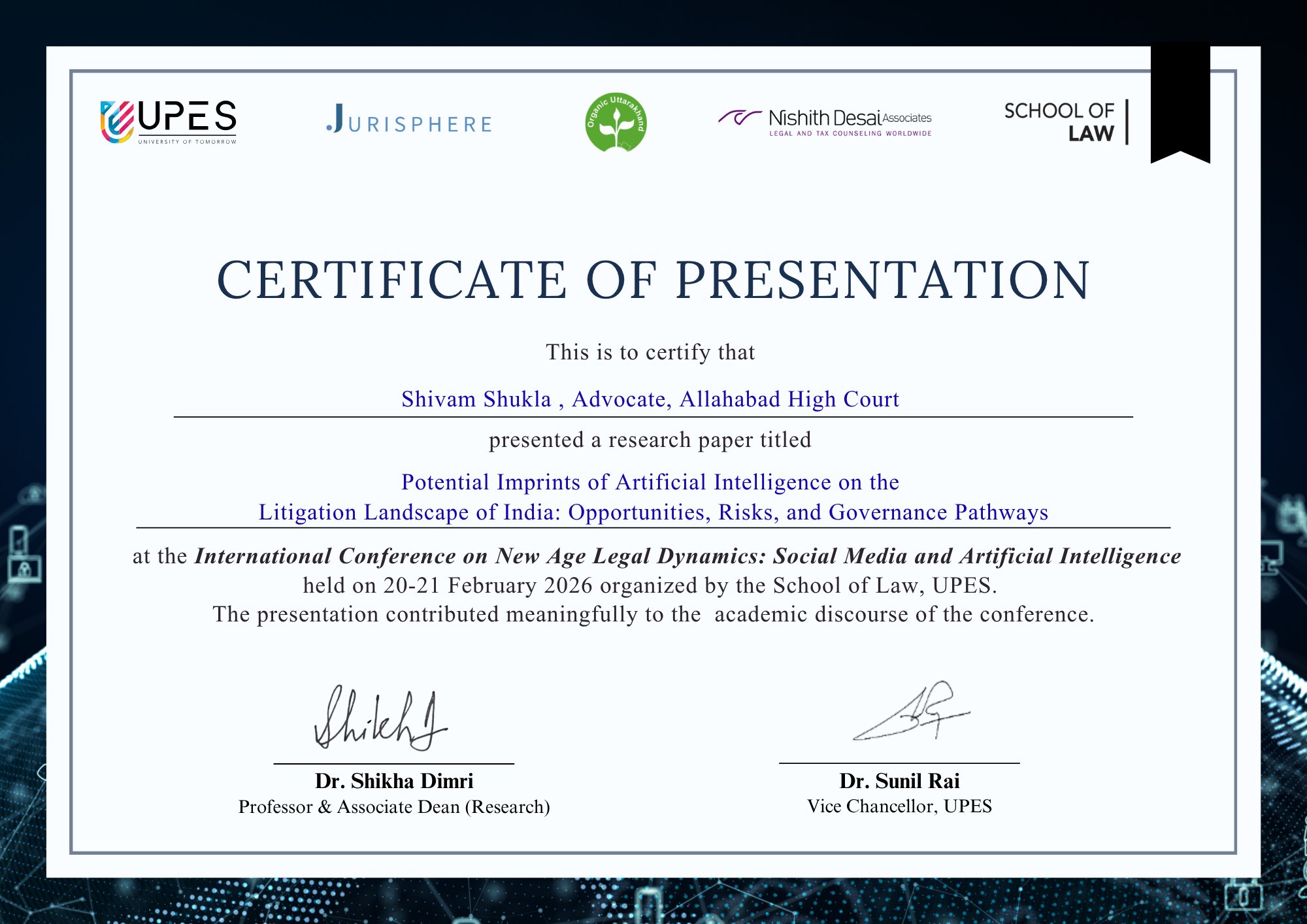
Potential Imprints of AI on the Litigation Landscape of India
International Conference on New Age Legal Dynamics: Social Media and Artificial Intelligence · School of Law, UPES, Dehradun · 20 to 21 February 2026 · Sole presenter
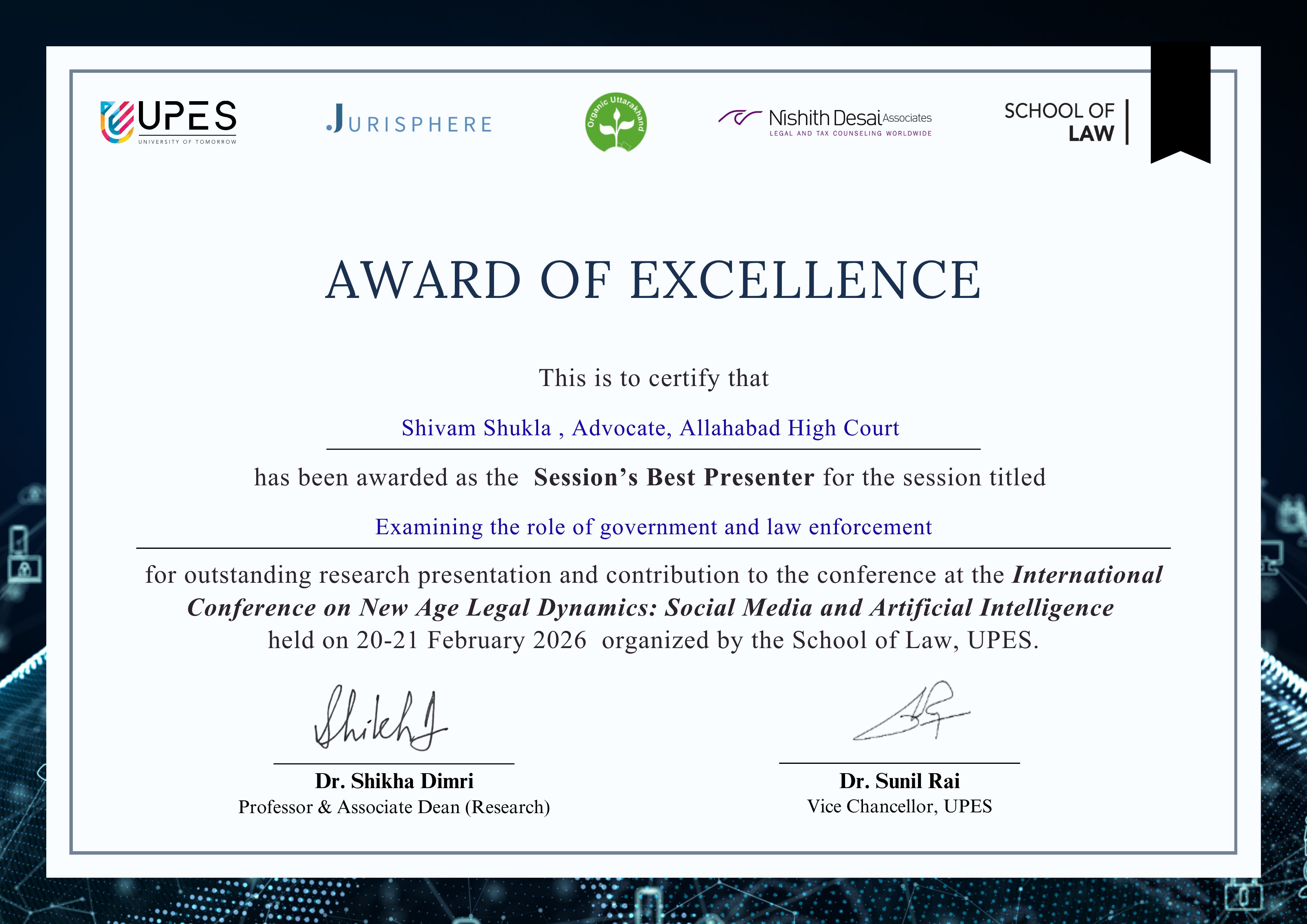
Research paper on the opportunities, risks, and governance pathways of artificial intelligence in Indian litigation. Conferred the Award of Excellence as Session's Best Presenter by the Vice Chancellor and the Associate Dean (Research), alongside the Certificate of Presentation.
The Declaration, seeded.
The Declaration on Responsible AI Use in Legal Practice and the System 1 Lawyering white paper were physically dispatched to the Supreme Court of India Registry and to the Chairman and Secretary of the Bar Council of India in March 2026. The instruments are published in full on the Standard page and within the SSRN working paper.
The Adversarial Standard.
Volume II of the series deploys the standard adversarially: detecting, challenging, and defeating AI-generated submissions, algorithmic state action, and machine-produced evidence, and delivering model professional guidelines, practice directions, and curriculum in adoptable form. Research phase through 2026; drafting after the Solidarity AI Conference in November; targeted for 2027. Details on the Book page.
Built by a practising advocate, from inside the courtroom, tested in active litigation, and published for the profession to adopt.
Why this work existsFor editors, conference organisers, and academic collaborators: correspondence on peer review, speaking engagements, and research collaboration is welcome at shivam@advshivamshukla.in or through the contact form.
Field Notes, dispatched.
Practitioner briefs on AI, law, and professional responsibility, written from inside the courtroom. Sent occasionally. No noise.